When you’re ready to do an upgrade to your home, carefully consider the scope of what you want to do and truthfully ask yourself if it will really add value to your home. Don’t make the mistake of overdoing it or upgrading in the wrong room or area. Think about resale. Will this change help you sell your house faster and for more money later on? What do most people want? It’s what sells houses – kitchens and bathrooms.
If you’re not going to do the work yourself or if you plan to act as General Contractor, do some research and find the best talent in the business to perform the individual tasks. Ask around. Check references. Find people that are people-oriented. And hire local – you’ll get faster service and help support your community. Consider the small business too. Any independent business that’s been around a while obviously takes pride in their work.
If you choose wisely, you’ll add immediate value to your home by going quality in materials and workmanship. And you’ll love your home even more. One of our favorites for that transforming tile work and flooring in the Walla Walla Washington area is Mark Robinson, 509-525-4677. A few of his talents are showcased in the picture below. This really ought to be on a magazine cover!
What’s in a name? Everything. Ever wonder what may have happened if the pop sensation ABBA had instead called themselves The Dimples? What if the rock group Van Halen had instead named themselves The Pen Pals? They would not have been taken seriously. Yes, the music may speak for itself, but would they really have been as successful? With a cheesy name we would have judged them completely differently! We’re very biased that way.
So it seems that names really do matter. Why else would so many music artists and actors create a stage name? Richard Starkey became Ringo Starr. Joan Marie Larkin became Joan Jett. Annie Mae Bullock became Tina Turner. Prince Rogers Nelson became Prince. Robert Ritchie became Kid Rock.
Then there’s Zoned, Sandstorm, Aviator, Debi DeAglio, Tommy Nova, Erwin Erwin, Ean Vianabon, Marcus James, and Patriot. Ever hear of them? If not, check them out – they’re pretty good for “no names.” :-)Bottom line, names matter. And so does the substance behind the name. The music. The acting. But there may be one exception to the importance of names.
In fact, beware of “stage” names and marketing gimmicks when it comes to money management firms and so-called financial experts. Is your money manager/advisor just a cleverly devised stage name stuffed shirt with expensive advertising and empty promises of making you successful, or is there really character and proven experience behind them? You’d better be sure, because your future will be affected so much by who you choose to help you win with your money. And in this case, the name really doesn’t matter.
In fact, the more real the name with money gurus probably the better. Street smarts and substance are everything here. Scott Krivoshein or Raymond James would do quite well. Erwin Erwin or Ean Vianabon…hmmm…
Lots of people are jumping on the internet band wagon to try to cash in. There are lots of ways. Aside from selling stuff directly, one of the most common ways to make money is through blogging. How it works is fairly simple in concept: You write and write diligently about things you are passionate about, and advertise on your blog with something like Google AdSense or Yahoo/Bing adCenter. As people come to your website and click on the ads you place there, you get paid! Pretty sweet, huh!
Setting up a website and getting ads on it is pretty easy. The hard part is getting people to come to your website. There are a lot of tricks you must learn to bring people to your web pages, like doing guest posting and guest articles on others’ websites, commenting on others’ blogs and in forums, joining blog communities/carnivals, joining directories, linking to other blogs, search engine optimization, using title tags and anchor text (text with hyperlinks), creating single web pages like Squidoo and more. The best article I’ve read on the subject is How To Make Money With A Blog. And here’s an article on how to get your website listed in The Open Directory.
I’m going to make this short and sweet, since the links I provide below will steer you to all the specific information you need to publish your book.
Self-publishing a book is pretty straightforward these days. There are certain hoops you must jump through (such as very specific document formatting) but there is help. In addition to being able to publish your book quite easily and fast, it is amazing that it costs virtually nothing out of pocket. As you sell books, the publisher will take a cut and give you a royalty. Since with ebooks there is no printing, inventory, storage, or shipping and handling, your royalty will be quite respectable. Even with print-on-demand hard copy books there is no inventory or storage so your royalty is still pretty substantial.
What a lot of people find difficult is getting started. How do you even begin to self-publish a book? I’ve found some resources that will get you “out there” real fast and relatively simply. I’ve personally used these so I know they work, especially with no prior self-publishing experience.
Your eBook Everywhere. If you want to publish an ebook version of your work, downloadable from mainstream ebook stores in nearly any ebook format, then I would recommend Smashwords.com. Smashwords is an excellent publishing resource. They will publish your book on Smashwords, Amazon/Kindle, iTunes/iPad/iBooks, Sony Reader, Barnes & Noble/Nook, Diesel, and more. In order to get your ebook in all these formats they have strict formatting requirements for your master file. But their free Smashwords Style Guide is one of the best guides I’ve ever seen for formatting using Microsoft Word. Perhaps the hardest part will be getting your master file in the correct format (or this may be easy for you if you’re a Word pro). The rest of the publishing process is pretty painless. If you get into trouble formatting your book, you can pay to have someone help you (they have recommendations for this). In addition to all the online listings of your ebook, you will also have your own listing and author page on Smashwords where the world can view a sample of your book. Smashwords will allow you to use electronic discount coupons for your book to help promote it. There are lots of other cool publishing features too.
Your Book Printed. If you want to publish and make hard copies (paperback) of your book available for sale on Amazon, and Barnes & Noble, then I would recommend Createspace.com. Their formatting requirements are doable without much pain and if you have the creativity to design your own book cover, you can do your entire book yourself. You can also pay to have various degrees of help with your book and/or the cover. In addition to your listing with Amazon, and Barnes & Noble, you will have your own listing on Createspace. You can buy your own copies from Createspace at a discount too, or have copies drop shipped to anyone you like. This is a great way to get your book into the hands of book reviewers and bloggers.
If you don’t want to pay for professional help with formatting, editing, or cover artwork, just make sure you get advice on how to do these things properly. The guides above will pretty much lay it all out. Your book will be competing with books that are done by other professionals so you’ll want to make sure your book measures up. For more tips check out A Newbie’s Guide to Publishing.
Once you publish your book, you’ll want to next figure out how to “get it known.” That is the tricky part. Most books that are published do not sell well. I don’t say this to discourage you. Some of the ones that do sell big have big publishing companies behind them. But there is also a growing number of self-published authors that have sold hundreds of thousands of copies. Some of it is luck, being at the right place at the right time – striking a nerve. It could be you. Go for it!
How do we learn and gain knowledge? While in some cultures story telling is how wisdom and experience are passed to the next generations, in most places throughout the world the most popular method is reading. And while plenty of ideas are cast into our homes through television, newspaper, radio and the internet, the majority of this information is for marketing purposes or with some specific not-good-for-you agenda in mind. Real understanding comes from reading real books and serious writings. The bookstore and library (and part of the internet) are rich with it. But there is a catch.
There, at some level, has to be a trust that what is written is true and wise. The distant past is impossible to verify, even yesterday. How then can we know that what’s written is correct? Sure, we can research and compare writings to other writings. But what if the majority of writings on a subject are biased? Then we can never know for sure. In the end it comes down to our research, belief and opinion that what others wrote about was accurate. And there’s one more complication.
Quite often, the best we have is a half-blind faith in the writings of people we know very little about. “Half-blind” because, while we’ve done the research, we don’t know the writers. And there are plenty of deceitfully crafty writers. So with this half-blind faith we may be being duped about a lot of things. Can we then really trust any writings at all? There is one measure worth considering.
Credibility is worth more than writing genius. Sincerity takes blind faith and turns it to knowing. But we can’t possibly know the author to determine integrity, can we? Here’s the thing: We can’t necessarily trust what was written about them, but we can determine credibility and sincerity in their writings. Yes, between the lines! While agenda and writing style often make more copy and get more notice, a fox can usually smell a fox regardless. And a rose ends up smelling like a rose.
Credibility is buried in the text of an author’s writings and it makes itself known to the avid reader. That is why we must read and read books and articles. But you say, “I don’t have time to read a lot.” Then narrow it down. Discernment is cultivated by reading the writings of people who help for the love of helping.
For example, if you want to know about personal finances (and more) there is author Daniel Murphy, giving away free advice for the love of it. And there are a host of others dedicated to writing about all kinds of things for which they’re passionate. You can probably find some roses if you look.
We are losing touch in this area, folks. We’ve seen reports that most people have not read a non-fiction book since high school! We are not reading, much less serious books or articles by writers doing it for the love of helping others. Instead we want to be entertained. If we’re getting all of our “higher education” from television, newspaper, radio and the trash-side-of-the-internet then we’re letting the fox outfox us. That, actually, explains a lot considering the state of financial affairs worldwide.
We do not know everything. And, sorry to break the bad news, you do not know everything either. Even if you study the rest of your life, you’ll never learn everything there is to know. And that’s okay, because someone you already know probably is a nerd about things that you are clueless about.
The kicker is knowing the limits to what you know. If you are too proud to ask for advice, then you’ll look (and buy) like a clueless person at the store. Ask for help and only your pride takes a hit. Either way your pride is getting smashed up, so limit the other damage to your wallet!
Computers are a classic example. Have you ever wasted a bunch of time and money trying to pick out a computer to purchase or fix your computer problem yourself? It’s always good to have a “teknonerd” available to contact if you have computer problems or need other technical advice on your electronics.
We have personally used the TeknoNerd in our area, got great help and advice, and saved time & money! They helped us fix some nasty computer virus problems and also steered us smart on a recent electronics purchase.
So don’t be too proud to ask for advice from others. Your wallet will thank you.
I just came across this great new book by Daniel Murphy, The Success Essentials. Just downloaded my copy (along with two FREE books) and started reading tonight. Can’t wait to read all three and put this stuff into practice – because yes, I want to be a success! This is not just about financial success – it applies to anything you want to succeed in.
Decades of experience (personal and reading others’ books) have enabled Daniel to boil all this down for my benefit. I’ve read lots of other stuff by Daniel and I already respect his experience and research. So I highly recommend this book. Get your copy now at http://www.thesuccessessentials.com/.
It seems that more and more, nothing is free. People don’t give stuff away, or advice (well, people do give away a lot of bad advice!). Usually there’s a catch. Either the free stuff is just a trinket to get you (or make you feel obligated) to buy the real thing, or it’s not really free at all after you pay the various fees, membership, or shipping/handling.
Have you ever heard of buying a music CD for one penny? Yes, you can find them online. But the kicker is that someone is going to make money on the shipping and handling. So it’s really not free, just a clever marketing ploy.
That’s why it is especially refreshing to come across a real person that IS giving away lots for free – information about personal finance and self help. No joke. Check out Daniel Murphy’s Books2Wealth at http://www.books2wealth.com/. This website provides a free newsletter, book reviews, articles and other resources to help you be wiser with money. And don’t miss Daniel’s Creating True Wealth Blog at http://www.ctwblog.com/.
Thanks Daniel for all of your great book reviews, guest articles, newsletters and just plain “help your neighbor” kind of attitude in sharing your love of reading books and writing reviews and blogs. We need more people like you – helping others. May you be prosperous too!


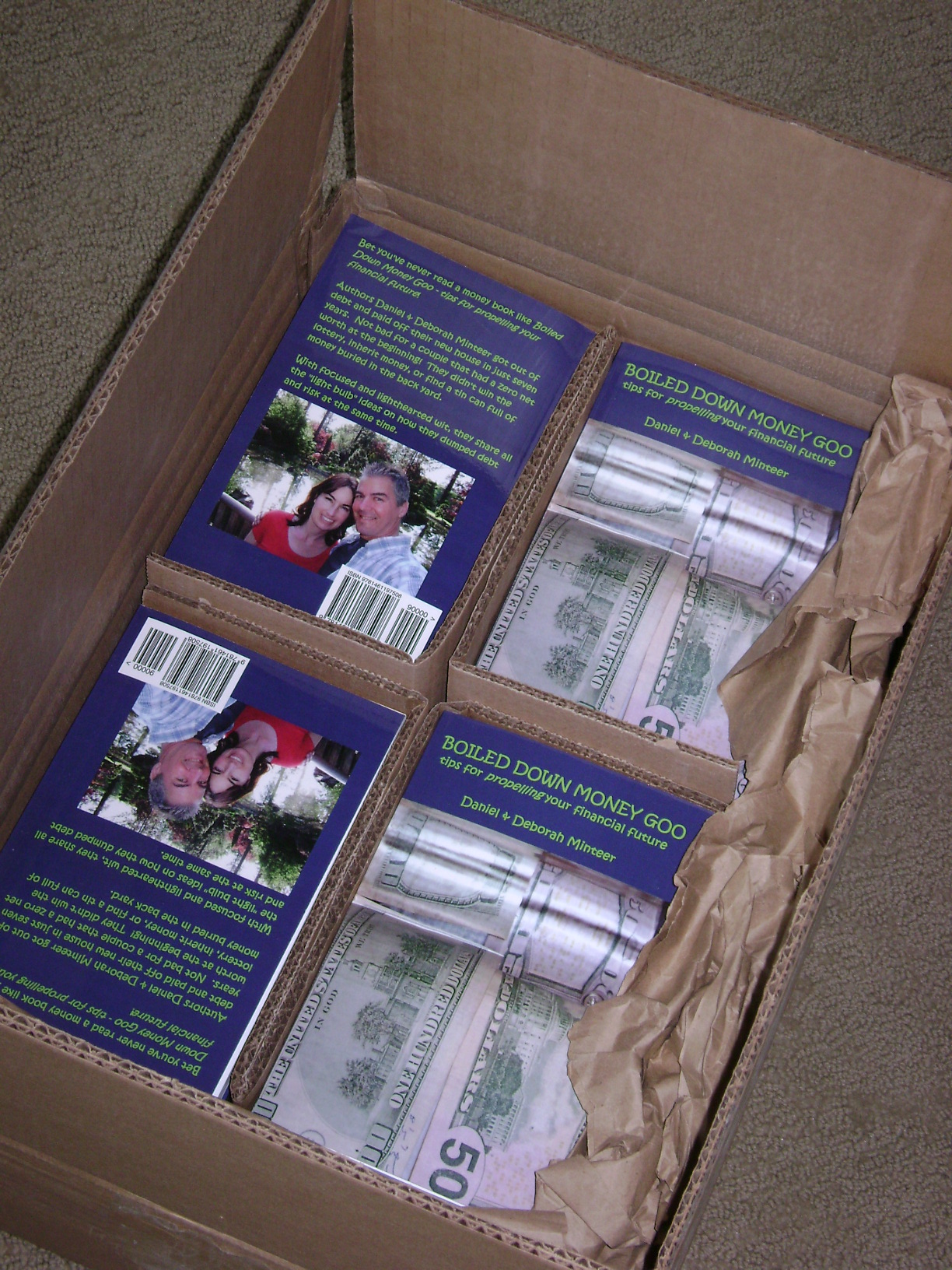


 Boiled Down Money Goo